Classic web results are only one piece of what a Google search results page actually shows, images, videos, local packs, and other verticals all appear alongside the ten blue links, each requiring its own ranking logic. What is Glue Google system, in short: it is the...

Updates & Recovery
How to Write an SEO Case Study People Actually Trust
The industry is full of SEO case studies claiming a single tweak tripled traffic overnight, and most of them share a common flaw: no control group, no measurement window discipline, and no acknowledgment of confounding factors. A genuinely credible seo case study...
HCU Recovery Signs: What Genuine Progress Looks Like
A site hit by the helpful content system, now folded into Google's broader quality reassessments rather than run as a fully separate classifier, often shows a confusing mix of small ups and downs during recovery, which makes distinguishing real progress from noise...
The Google Leak: A Complete Guide to What It Revealed
In May 2024, over 2,500 pages of internal Google API documentation, detailing more than 14,000 potential ranking attributes, became public. The google leak remains the single largest, most detailed unofficial look at Google's ranking infrastructure ever released, and...
Twiddlers Google Ranking Explained: The Re-Rankers
Most SEO discussion treats Google's ranking process as one algorithm producing one ordered list. The leaked API documentation revealed something closer to a pipeline: an initial ranking, followed by a whole layer of adjustment functions applied just before results are...
How Algorithm Updates Changed Gaming Content Rankings
Gaming content rankings changed sharply between 2022 and 2024, as Google's helpful content updates and the March 2024 core update shifted visibility away from generic, aggregated content and toward pages showing genuine first-hand experience. Gaming sites built on...
Navboost Engagement Signals: Why Some Dog Content Ranks and Some Doesn’t
Navboost engagement signals are the user interaction data, mainly clicks on search results, that Google's Navboost system uses to refine rankings for specific queries. Navboost was described publicly during the US Department of Justice antitrust trial against Google...
E-E-A-T Personal Finance: Why Google Scrutinizes YMYL Sites Most
E-E-A-T personal finance standards are stricter than in most niches because financial advice can cause real harm if it is wrong. Google's Search Quality Rater Guidelines classify topics that could significantly affect a person's financial stability as Your Money or...
How to Know Which Update Hit Your Site, Reliably
Every unconfirmed dip in the SEO world gets blamed on "an update," often incorrectly. Knowing how to know which update hit your site, specifically, rather than assuming the most recently discussed one is responsible, is a diagnostic skill worth building deliberately....
Why Did My Traffic Drop After Core Update? A Checklist
The rollout finishes, you check your dashboard, and the graph is pointing the wrong way. Before panicking or making sweeping changes, work through this checklist in order, since "why did my traffic drop after core update" deserves a real diagnosis, not a guess. "Why...
Google API Leak Findings Summary: What Actually Leaked
In May 2024, over 2,500 pages of internal Google API documentation, detailing more than 14,000 potential ranking attributes, became public through what appears to have been an accidental exposure rather than a hack or whistleblower disclosure. This google api leak...
Site Reputation Abuse: Google’s Parasite SEO Crackdown
For years, a well-known SEO tactic involved buying placement on a large, trusted publication's coupon or review section, letting that domain's existing authority carry thin third-party content straight to the top of search results. Site reputation abuse is Google's...
Scaled Content Abuse: Google’s Official Policy Explained
Scaled content abuse gets misread constantly as "Google penalizes AI content," and that misreading causes a lot of unnecessary panic and equally unnecessary confidence. Google's actual policy, introduced in the March 2024 spam update, is more specific than that, and...
Algorithm Update Recovery: A Realistic Timeline and Plan
Confirm the Timeline Before Doing Anything Before making a single change, verify a core update actually rolled out during your traffic drop by checking Google's Search Status Dashboard against your own analytics timing. Core updates typically take one to four weeks to...
Manual Action: What It Is and How to Actually Recover
A manual action is when a member of Google's Search Quality team, a real person, has personally reviewed a site and applied a penalty for violating Google's guidelines. Unlike an algorithmic penalty, this is not automatic, and it always comes with a paper trail: a...
Algorithmic Penalty: How It Differs From a Manual
Your traffic drops, you check Search Console, and the Manual Actions report says "no issues detected." That is not good news, it just means you are dealing with an algorithmic penalty instead of a human-reviewed one, and the two require completely different recovery...
Navboost: Google’s Click-Based Re-Ranking System Explained
For over a decade, Google publicly denied that clicks directly influenced search rankings. Then, during the 2023 US v. Google antitrust trial, Google's own VP of Search testified under oath that a system called navboost is "one of the most important ranking signals"...
Search Quality Rater: What They Do and Why It Matters
Every few months, someone in an SEO forum claims that a search quality rater personally downgraded their site, and someone else corrects them: raters cannot touch your rankings directly. Both halves of that exchange miss the more useful point. A search quality rater...
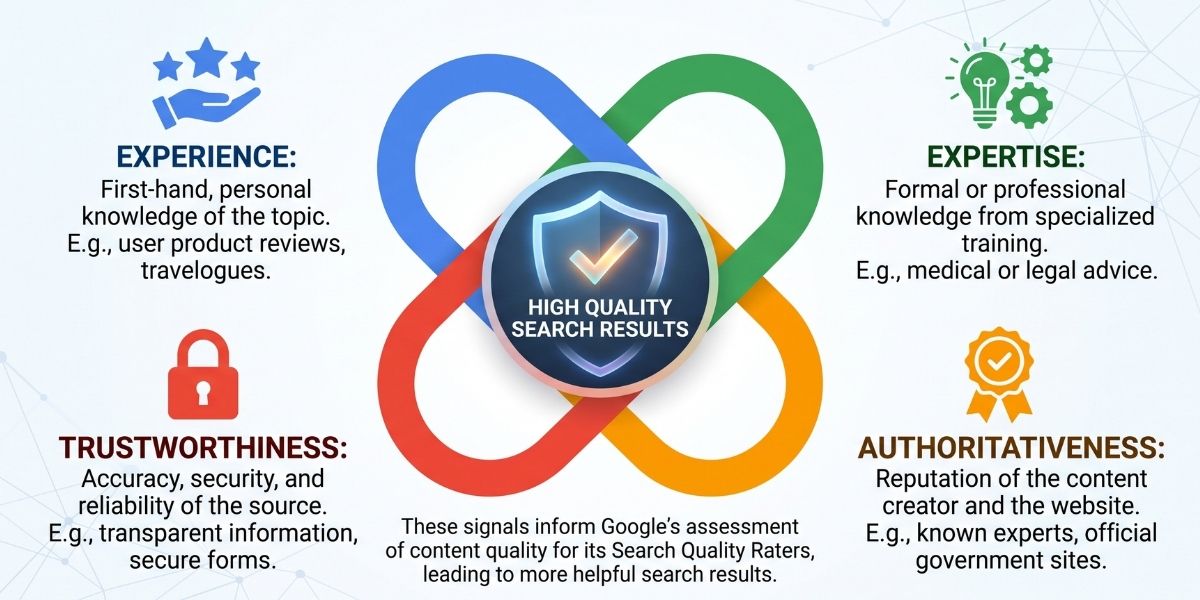
Google’s E-E-A-T Framework: How to Build Trust Signals on a New Website in 2026
For most of its existence, Google's E-E-A-T framework was treated as a concern for health and finance sites. If you were writing about medical symptoms or investment advice, you needed credentials, named authors, and verifiable expertise. If you were writing about...
Google March 2026 Core Update: What Actually Changed and Who It Hit
When Google confirmed the March 2026 core update on March 4th, the initial reaction across the SEO community was the usual mix of panic, speculation, and contradictory advice. Tracking tools registered volatility levels higher than any previously recorded update....