
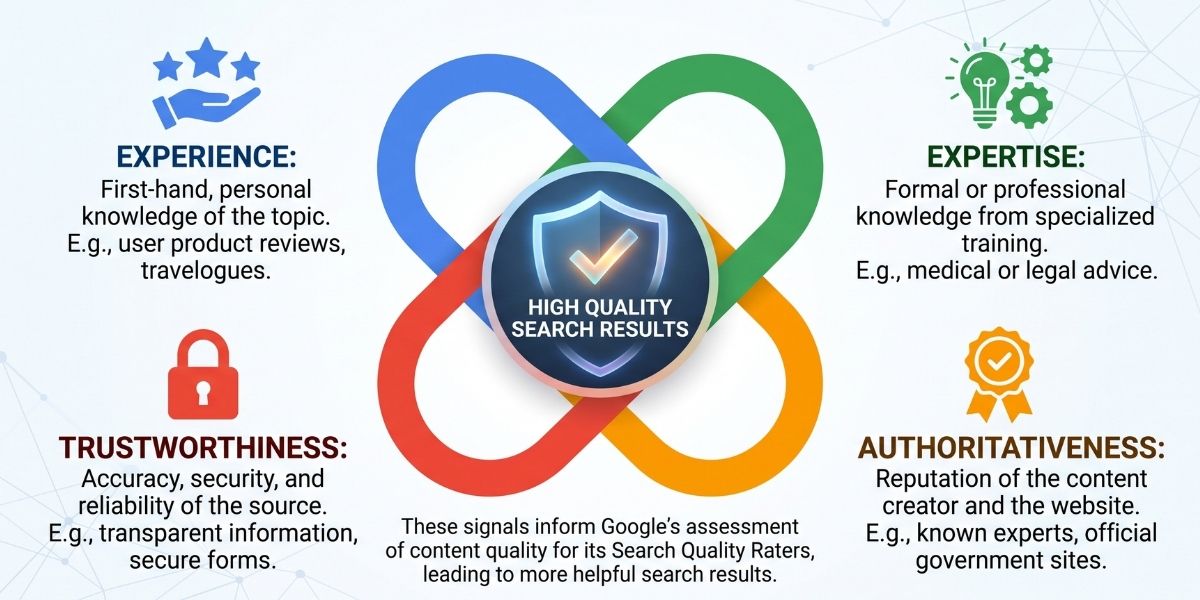
E-E-A-T personal finance is one of the most consequential applications of Google's quality evaluation framework, and running a personal finance site has given us a front-row seat to how those standards are applied in practice. The Experience, Expertise, Authoritativeness, and Trustworthiness framework applies across every niche, but its teeth are sharpest in the Your Money or Your Life category, and personal finance sits at the top of that list alongside medical and legal content.
Understanding how E-E-A-T personal finance evaluation works is not just useful for finance publishers. It is a clear window into how Google's quality systems operate at their most demanding, and the lessons transfer to any niche where advice can cause real harm if it is wrong.
Why Personal Finance Triggers the Strictest E-E-A-T Scrutiny
E-E-A-T personal finance scrutiny exists because the stakes are genuine. A reader who follows incorrect debt payoff advice, chooses the wrong insurance product, or misunderstands an investment strategy faces real financial damage that can take years to undo. Google's quality raters are trained to apply heightened scrutiny to content in categories where downstream harm is possible, and personal finance is explicitly named in Google's Search Quality Evaluator Guidelines as requiring the highest standard of evaluation.
The practical effect of E-E-A-T personal finance scrutiny on rankings is visible in competitive finance search results. KatvTech's E-E-A-T framework guide covers how trust signals build across a new site's architecture. Sites with documented author credentials, transparent editorial processes, and clear organizational accountability consistently outrank sites with stronger backlink profiles but weaker trust signals. The 2018 Medic update was the public signal that Google's systems had started weighting quality signals more heavily than authority signals in YMYL categories, and every core update since has moved further in that direction.
The Four Dimensions Applied to Finance Content
Experience in the E-E-A-T personal finance framework means demonstrated first-hand knowledge of the financial situations being discussed. A debt payoff guide written by someone who has navigated debt payoff produces specific, granular details that a synthesized overview cannot replicate: the emotional reality of the process, the decision points that generic advice glosses over, and the practical adaptations that real-world application requires.
This shapes how we approach every piece of content. An article about paying off credit card debt is more credible when it acknowledges the specific behavioral challenges that make debt payoff hard, not just the mathematical mechanics. Google's quality systems are increasingly capable of distinguishing between content that reflects genuine experience and content that describes the experience from the outside.
Expertise means verifiable professional knowledge. Certified financial planners, CPAs, licensed insurance professionals, and financial journalists with documented publication histories all provide expertise signals that anonymous authors cannot. The author credentialing infrastructure - profile pages with professional backgrounds, bylines on published work, credentials linked to verifiable registries - converts an expertise claim into an expertise signal that Google's systems can evaluate.
Authoritativeness accumulates through citations from authoritative sources: links from established financial publications, mentions in mainstream media, and the reference patterns that indicate the site is being treated as reliable by others in the space. Trustworthiness is the dimension finance sites most commonly fail on technical grounds: missing contact information, unclear ownership, aggressive monetization patterns, and the absence of update processes that would catch and correct errors over time.

What Core Updates Have Done to E-E-A-T Personal Finance Rankings
The core updates since 2018 have consistently rewarded E-E-A-T personal finance signals at the expense of sites that ranked on traditional authority signals without the underlying quality infrastructure. The September 2023 helpful content system integration, which folded the helpful content classifier into the core ranking system, accelerated this dynamic: sites producing content primarily for search engines rather than for genuine readers saw the most significant traffic losses.
Why traffic drops after a core update is the diagnostic checklist that comes before any recovery work. Recovery for E-E-A-T personal finance sites hit by core updates follows a consistent pattern: genuine author credentialing improvements, updating of stale content to reflect current financial products and regulatory environments, removal of thin pages that undermine overall site quality, and editorial process documentation that makes the quality commitment visible.
The AI search layer adds a parallel evaluation. ChatGPT and AI Overviews apply a version of the E-E-A-T personal finance framework when deciding what to cite, and the finance content earning AI citations is almost uniformly from sites with the strongest trust infrastructure in the traditional search environment. The signals compound across both systems, making the investment in genuine E-E-A-T infrastructure the highest-return technical SEO decision available to a finance publisher.
Guest Author: This post was contributed by BrollBros, a personal finance site covering budgeting, debt, loans, and investing in plain, practical language.

Want to share your story, expertise, or unique perspective with our audience? We’re always looking for fresh voices – drop us a line or head over to our contact page to get started!