
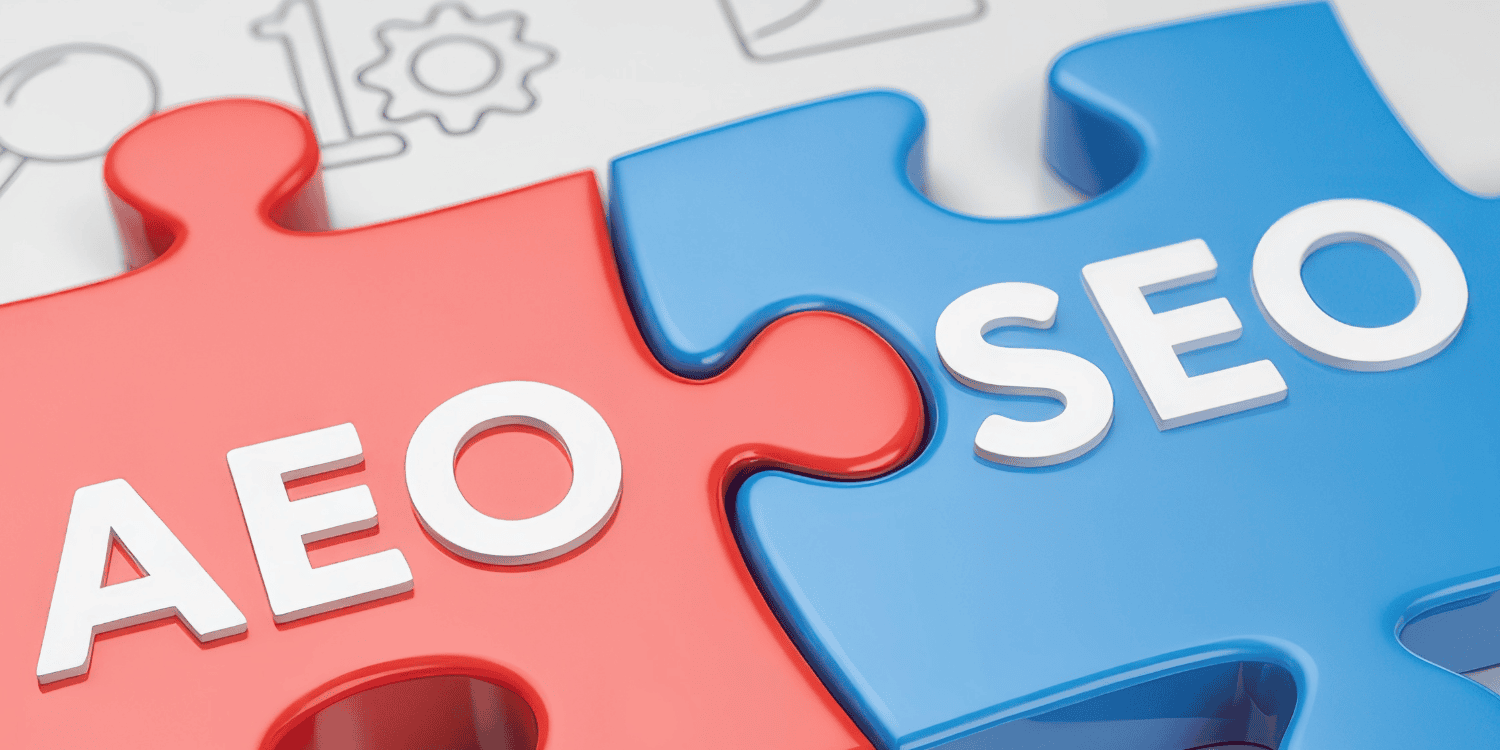
We have spent years trying to understand how Google ranks websites and find ways to bring content to the top of the search results. Then the rules changed. The updates of 2025 and 2026 shifted the goalposts significantly enough that much of what we had learned needed to be revalidated from scratch. That uncertainty is part of what pushed us to launch KatvTech. As a new era of search ranking takes shape, documenting it in real time seemed more useful than waiting until the dust settled.
For most of the last two decades, ranking in Google meant appearing as a blue link in a list of ten results. The goal was position one. The metric was clicks. The discipline was SEO.
That model is still relevant. But it is no longer the complete picture. A growing proportion of Google searches now return an AI-generated answer at the top of the page, synthesised from multiple sources, with citations. Users read the answer and frequently do not click through to any of the cited pages. The click never happens. But the citation does.
This shift created a new optimisation discipline. The goal is no longer only to rank. It is to be cited. That is what Answer Engine Optimisation addresses, and it is what this article explores.
We are still learning. Every experiment we run refines our understanding and occasionally overturns an assumption we were confident in. What we publish here is not a finished playbook. It is a live record of what the data shows us, updated as we find out more.
What does AEO stand for?
AEO stands for Answer Engine Optimisation. It refers to the practice of structuring and formatting content so that AI-powered answer systems, including Google's AI Overviews, ChatGPT, Perplexity, and similar tools, select your content as a source when generating responses to user queries.
We think AEO is on the same trajectory SEO was in the early 2000s. The term is new, the discipline is poorly understood outside a small group of practitioners, and the majority of content sites have not started implementing it. That gap will close quickly. Within three to five years we expect AEO fluency to be as baseline an expectation as keyword research is today.
That does not mean SEO becomes irrelevant. The data suggests the opposite. SEO remains the foundation that AEO is built on. A page that does not rank organically is almost never cited in an AI-generated answer. The two disciplines are not competing; they are sequential. You earn organic visibility through SEO. You convert that visibility into AI citations through AEO.
The term reflects a shift in how search engines are being used. Traditionally, a search engine was an index of links. Users submitted a query and received a ranked list of pages to visit. An answer engine does something different: it reads the available sources and generates a synthesised answer, then optionally cites the sources it drew from. Optimising for an answer engine means making your content the source an AI system trusts enough to cite.
How is AEO different from traditional SEO?
SEO and AEO share a foundation. Pages that rank well organically are significantly more likely to be cited in AI-generated answers. Research published in early 2026 found a 92 percent correlation between pages appearing in Google's top 10 organic results and pages cited in AI Overviews for the same queries. You cannot skip SEO and jump directly to AEO.
Where they diverge is in what happens after a page earns visibility.
Traditional SEO optimises for the click. The goal is a title and meta description compelling enough that a user chooses your result over the nine others on the page. Once they click, SEO's job is largely done.
AEO optimises for extraction. The goal is content structured so clearly and answered so directly that an AI system can identify the relevant passage, extract it accurately, and cite it with confidence. The user may never visit your page. The citation is the outcome.
This changes what good content looks like at a structural level. SEO-optimised content can bury the answer after a long introduction. AEO-optimised content cannot. The direct answer must appear in the first 40 to 60 words under each heading, because that is where AI extraction systems look first. We believe this is where traditional website structure will see its biggest evolution over the next few years. Not in design or navigation, but in how content is sequenced and surfaced at the paragraph level.
Whether you can skip SEO entirely and still earn AI citations is actually an experiment worth running. We have not tested it yet. If that is something you want us to prioritise, let us know through the contact page and we will add it to the experiment queue.
Why does it matter that 69 percent of searches end without a click?
Zero-click searches, searches where users get what they need from the search results page itself without visiting any website, now account for 69 percent of all Google searches according to data published in early 2026. For informational queries, the proportion is even higher.
This means that for a large share of searches, the traffic model that content sites have relied on for two decades is simply not generating visits. The user asked a question, Google answered it, the user moved on. No click, no pageview, no ad impression, no affiliate conversion.
AEO addresses this by reframing the objective. If a user asks Google what the best camera for beginners is and Google's AI Overview answers the question by citing your review, that citation puts your brand, your site name, and your positioning in front of the user at the exact moment they are making a decision. Even without a click, that is a meaningful exposure. And the users who do click through from an AI citation are significantly higher intent than average organic visitors, because they have already read a synthesised answer and chosen to go deeper.
That is the theory, at least. The honest position is that we understand how search behaviour is changing faster than we understand how that change translates into measurable business outcomes. The conversion data on AEO-driven traffic is still thin, the sample sizes are small, and the discipline is too young to have produced reliable benchmarks. What we can say with confidence is that the direction of travel is clear. We expect the picture to sharpen considerably over the next two to three years, and documenting that process in real time is a large part of what this site exists to do.
How do AI systems decide which sources to cite?
AI Overview citation is not random and it is not simply a function of ranking position, though ranking position matters. Based on the research we have reviewed and the experiments we are running, citation decisions appear to weight several factors consistently.
Content structure. Pages with clear question-based headings and direct answers immediately below those headings are cited more frequently than pages with equivalent information presented in unstructured prose. The AI system needs to be able to locate the answer quickly and extract it cleanly.
Factual specificity. Vague generalisations are rarely cited. Specific claims with numbers, dates, named sources, or measurable outcomes are cited at a higher rate. An AI system generating an answer needs citable facts, not summaries of conventional wisdom.
Schema markup. Pages with FAQ Page schema, Article schema, and properly structured BreadcrumbList data are more legible to AI systems than unstructured pages. Schema tells the system what type of content it is looking at and how the content is organised.
Content freshness. Pages updated within the last 12 months account for 83 percent of AI Overview citations according to research published in 2026. Stale content is deprioritised regardless of its quality at the time of original publication.
Source authority. Established domains with clear topical focus, verifiable authorship, and external citations pointing to them are cited more frequently than new or anonymous sites covering the same information. This is the E-E-A-T dimension of AEO.
The numbers above will sharpen as our experiment data accumulates. They will also shift as Google continues developing its AI Overview systems, which are still relatively early in their deployment. Google is actively adjusting citation behaviour, weighting criteria, and display formats on their end at the same time we are trying to measure them on ours. We will update this section as the data changes, and flag any significant revisions at the top of the article with a date so returning readers can see what moved and when.
What content structure gets cited in AI answers?
Based on our ongoing AEO research, the content structure that produces the highest citation rate follows a consistent pattern across different query types and niches.
Each section of the article begins with an H2 heading phrased as a question. The question should match, as closely as possible, the language a real user would type or speak into a search interface. Not "Types of cameras" but "What are the different types of cameras?" The question format is how AI systems identify that a section is attempting to answer a specific query.
The first paragraph under that heading delivers the direct answer in 40 to 60 words. This is not an introduction to the answer. It is the answer itself, stated completely and specifically enough that an AI system could extract it and present it as a standalone response. Everything that follows in the section elaborates, qualifies, or provides evidence for the direct answer.
At the end of the article, a FAQ section adds 5 to 8 additional question and answer pairs targeting related queries. These are marked up with FAQ Page schema, which increases the probability of appearing in People Also Ask results and AI Overview panels simultaneously.
Is AEO replacing SEO or adding to it?
AEO is adding to SEO, not replacing it. The 92 percent correlation between organic top-10 rankings and AI Overview citations makes this unambiguous: pages that do not rank organically are almost never cited in AI-generated answers. The foundation of organic ranking, technical health, topical authority, E-E-A-T signals, and quality content, remains the prerequisite.
What AEO adds is a layer of structural optimisation that makes already-ranking content more extractable by AI systems. A page that ranks in position four but is structured for AEO will often be cited in AI Overviews ahead of the pages ranked above it, because the AI system can extract a clean, direct answer from it more easily than from the competing pages.
The practical implication for content site builders in 2026 is that SEO and AEO should be implemented simultaneously from the first article, not sequentially. Writing question-based H2s, providing direct answers in the first paragraph of each section, and adding FAQPage schema adds negligible time to the content production process. The compound effect over 12 to 18 months of consistently structured content is significant.
At KatvTech, we are running controlled experiments to isolate which AEO factors produce measurable citation rate improvements and by how much. The results are published in the AEO Research category as they become available.
What does AEO stand for?
AEO stands for Answer Engine Optimisation. It is the practice of structuring and formatting content so that AI-powered answer systems, including Google AI Overviews, ChatGPT, and Perplexity, select your content as a cited source when generating responses to user queries.
Can you do AEO without doing SEO first?
No. Research in 2026 found a 92 percent correlation between pages ranking in Google's organic top 10 and pages cited in AI Overviews. Pages that do not rank organically are almost never cited in AI-generated answers. SEO is the prerequisite. AEO is the additional layer built on top of it.
How do you know if your content is being cited in AI Overviews?
Google Search Console does not currently separate AI Overview traffic from standard organic traffic, so direct measurement is limited. The most reliable method is manual checking: search your target queries in Google and observe whether an AI Overview appears and whether your site is cited. Third-party tools including SE Ranking and BrightEdge have begun offering AI Overview tracking features as of 2026.
Does schema markup help with AEO?
Yes. FAQPage schema, Article schema, and BreadcrumbList schema all make content more legible to AI systems by providing explicit signals about content type and structure. Pages with complete schema markup are cited more frequently than structurally equivalent pages without it, based on the citation pattern research we have reviewed.
How often should you update content for AEO purposes?
Pages updated within the last 12 months account for 83 percent of AI Overview citations. For high-value content targeting competitive queries, updating at least every 6 months is advisable. Updates should involve substantive additions or corrections, not only a changed date. Adding a new data point, updating a statistic, or expanding a section with recent findings counts as a meaningful update

David Brauksworth is KatvTech’s Technical SEO Analyst, specializing in Core Web Vitals, crawl budget, and site architecture. He runs controlled CWV and indexing experiments and tracks pattern shifts across Google’s core and spam updates.