
Navboost engagement signals are one of the ranking factors we have paid the most attention to at The Barking Deck, because the pet content niche produces some of the clearest evidence that traditional SEO signals do not fully explain competitive rankings. Sites with weaker domain authority and fewer backlinks consistently outrank stronger sites for specific dog health and training queries, and Navboost engagement signals are the most consistent explanation for that gap.
Navboost was confirmed as a real Google ranking system through the DOJ antitrust case documentation released in 2023, which named it explicitly and described its function: incorporating user interaction signals into ranking decisions at the query level. KatvTech's full Navboost explainer covers the technical detail of how the system operates, including the query-level model structure confirmed in the antitrust testimony. Understanding what those signals are, how they are generated by pet content specifically, and how to optimize for them has changed how we structure every piece of content we publish.
What Navboost Engagement Signals Actually Measure
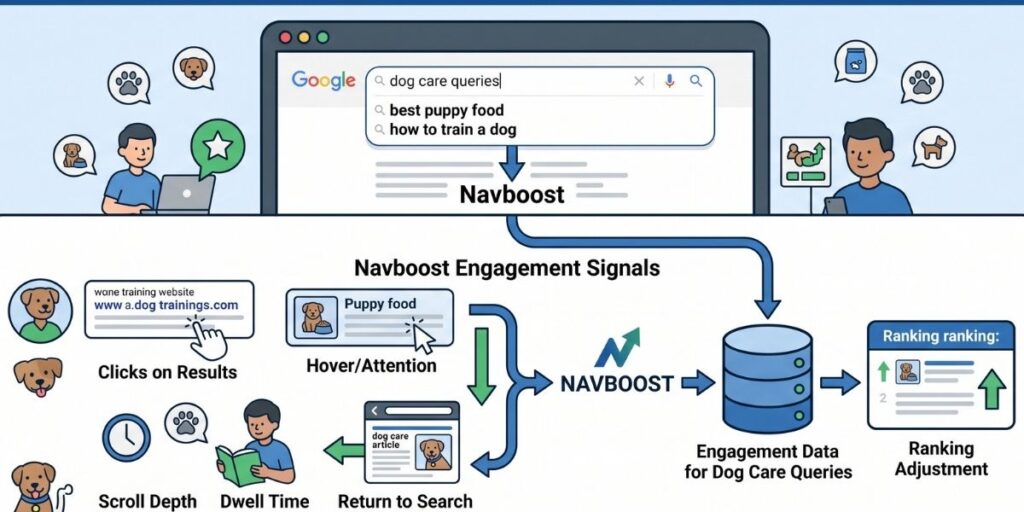
Navboost engagement signals track how users interact with search results for specific queries over time: which results get clicked, how long users spend on the resulting pages, whether they return to the search results page quickly, and whether they engage with the same result again in future sessions. The system builds a query-level model of which results satisfy users and which do not, and uses that model to adjust rankings for those queries.
The click-through rate component is the most directly actionable Navboost engagement signal for content publishers. A page that consistently receives a higher-than-expected click rate for a specific query is building a positive Navboost signal that functions as a ranking boost for that query. Title tags and meta descriptions, which determine what appears in search results, are therefore Navboost optimization tools as much as they are traditional SEO elements.
The time-on-page component is the signal that pet content is particularly well-positioned to generate. Dog health and training queries are high-urgency, high-engagement searches: users who arrive at a genuinely useful answer to a dog health question read thoroughly, often revisit the page, and frequently navigate deeper into the site for related information. A dog health article that answers its primary query completely and connects naturally to related content on the same site generates the kind of user behavior that Navboost reads as strong satisfaction.
The bounce-back rate - the proportion of users who return to search results immediately after clicking a result - is the negative Navboost engagement signal that most directly reflects content quality at the query level. Pet content that buries the answer to the user's specific question behind extensive preamble generates high bounce-back rates because users in a high-urgency state do not wait for the answer. Content that leads with the answer generates low bounce-back rates because the user's primary need is met immediately.
Why Pet Content Has a Distinctive Navboost Profile
Pet content Navboost engagement signals differ from most content categories because the user intent is unusually specific and the satisfaction signals are unusually clear. A user searching for "can dogs eat grapes" has a binary information need: yes or no, with the reason. A page that answers that question in the first two sentences generates immediate satisfaction and a strong positive Navboost signal. A page that takes four paragraphs to reach the answer generates a bounce-back signal that compounds negatively over thousands of impressions.
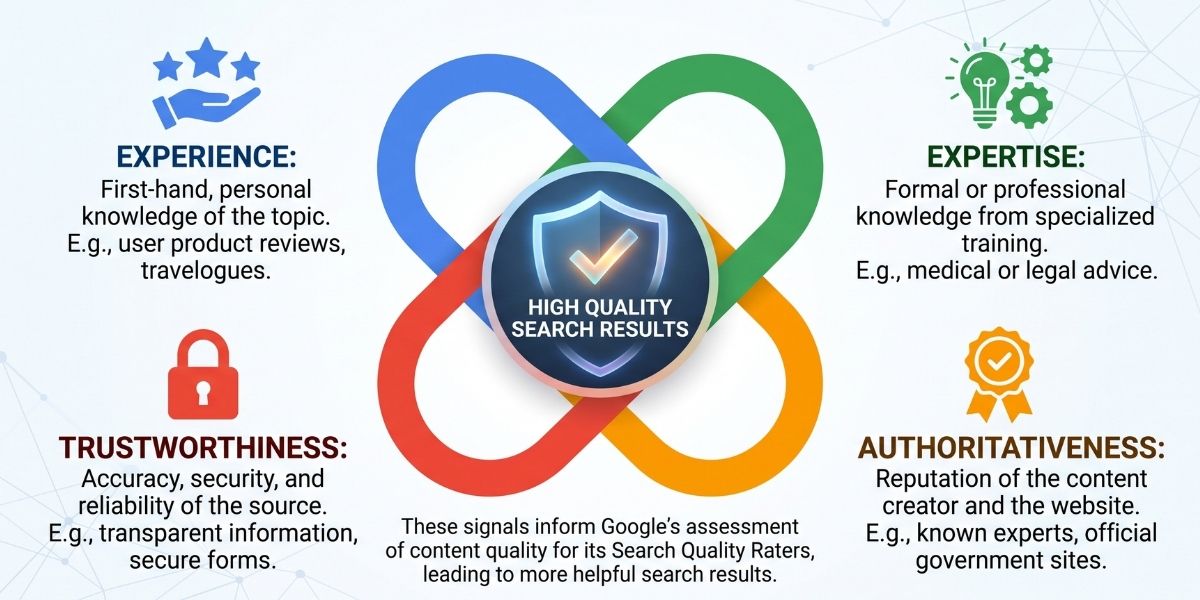
Understanding what search quality raters are evaluating helps calibrate the content standard. The pet content that earns the best Navboost engagement signals is consistently the content that would also score well in a human quality review: answers the question directly, provides genuine supporting context, and connects to related content the user might need next.
The competitive implication is significant: a pet site with weaker domain authority but stronger Navboost engagement signals for specific queries will outrank a stronger site with worse user satisfaction metrics for those queries. Traditional SEO authority is a baseline. Navboost engagement signals are the adjustment that explains why the baseline prediction is consistently wrong for certain queries.
Optimizing Pet Content for Navboost Engagement Signals
The above-the-fold experience is the primary Navboost engagement signal optimization lever for pet content. The first 200 words determine whether the user who arrived from search stays or bounces immediately, and the Navboost system reads that stay-or-leave decision across thousands of sessions for each query to build its ranking model.
The most effective structural change is leading with the direct answer to the query implied by the title before expanding into supporting context. For dog health content specifically, the user's decision sequence is almost always: what is the answer to my immediate question, then why, then what should I do about it. Content structured in that order generates the engagement pattern that Navboost rewards.
Internal linking to related pet content on the same site is the Navboost engagement signal optimization that most publishers underinvest in. A user who arrives at a dog health article, finds the answer, and navigates to a related article on the same site generates a session signal that is strongly positive. The uwageronit.com post on combat sports science applied to dog health illustrates this: it leads with the direct answer, connects to related dog health content, and is structured around the user's decision sequence rather than the writer's preferred narrative order.
Guest Author: This post was contributed by The Barking Deck, a practical guide to dog ownership covering health, training, and everything in between.

Want to share your story, expertise, or unique perspective with our audience? We’re always looking for fresh voices – drop us a line or head over to our contact page to get started!